“A lot of people cannot afford this,” Council member Lori Foster said of water rates as council members reviewed Step 1 water increases Monday, Sept. 15 during a committee of the whole …
This item is available in full to subscribers.
To continue reading, you will need to either log in, using the login form, below, or purchase a new subscription.
If you are a current print subscriber, you can set up a free website account and connect your subscription to it by clicking here.
Otherwise, click here to view your options for subscribing.
Please log in to continue |


“A lot of people cannot afford this,” Council member Laurie Foster said of water rates as council members reviewed Step 1 water increases Monday, Sept. 15 during a committee of the whole discussion on increased water rates. “I’ve had to cut back. A lot of people have families.”
With city water rates proposed to double at Stanley, the question arises: how do the current city water rates compare to other municipalities?
We did a comparison, courtesy of Wisconsin Public Service Commission (PSC) records.
Starting with current Stanley rates, Stanley Municipal Waterworks rates as currently set are $6.69 per 1,000 gallons for a standard residential connection, $7.08 per 1,000 gallons for multifamily, $6.01 per 1,000 gallons for commercial, $5.16 per 1,000 gallons for industrial customers, $6.74 per 1,000 gallons for public authority customers, and $4.87 per 1,000 gallons for ACE Ethanol LLC. ACE Ethanol inked a developer’s agreement with the city back in 2001, the city looking not to have special rates for anyone in the current update. Step 2 would add an additional 59 percent to the Step 1 increase of 44.63 percent. Alderperson Jason Meyer had a question for Henke.
“My main question is increase of cost,” Meyer asked Henke Sept. 15. “Is it going to be shared?”
“Everyone’s rate is going up,” Henke said, with individual bills would dependent on water usage. No official rate increases are available from the PSC at present, meaning only the current rates can be compared to other municipalities. Increases at Stanley would be used to pay for operating expenses, ozone and SCADA upgrade, the Central Water Plant upgrade, and a Well 3 update. Alderperson Terry Metzger asked why the water rate increase wasn’t done gradually instead, with Pilgrim saying it was to correct not having step by step increases done in the past.
“The simplified rate case wasn’t done yearly,” Pilgrim said of rates under previous city administrations, the last increase done in 2017. Recognized in turn with application made to the PSC for a rate correction, the conventional rate increase is being done to correct the oversight.
“Overall increase is step 1 plus step 2,” Pilgrim said of the water rate increase “No additional information has been provided regarding breakdowns. Only water is affected, not sewer. We do not know how increase will be reflected in the volume, fixed fees, public fire portions yet.”
Current general meter service charges are set at $24.00 for a 5/8 inch or 3/4 inch meter standard connection, $42.00 for a one inch connection, $54 for a 1 1/4 inch meter connection, $63 for a 1 1/2 inch meter connection, and $90 for a two inch connection. From there it rises, a three inch connection $159, four inch $240, six inch $420, 10 inch $900, and a 12 inch connection $1,200, billed quarterly.
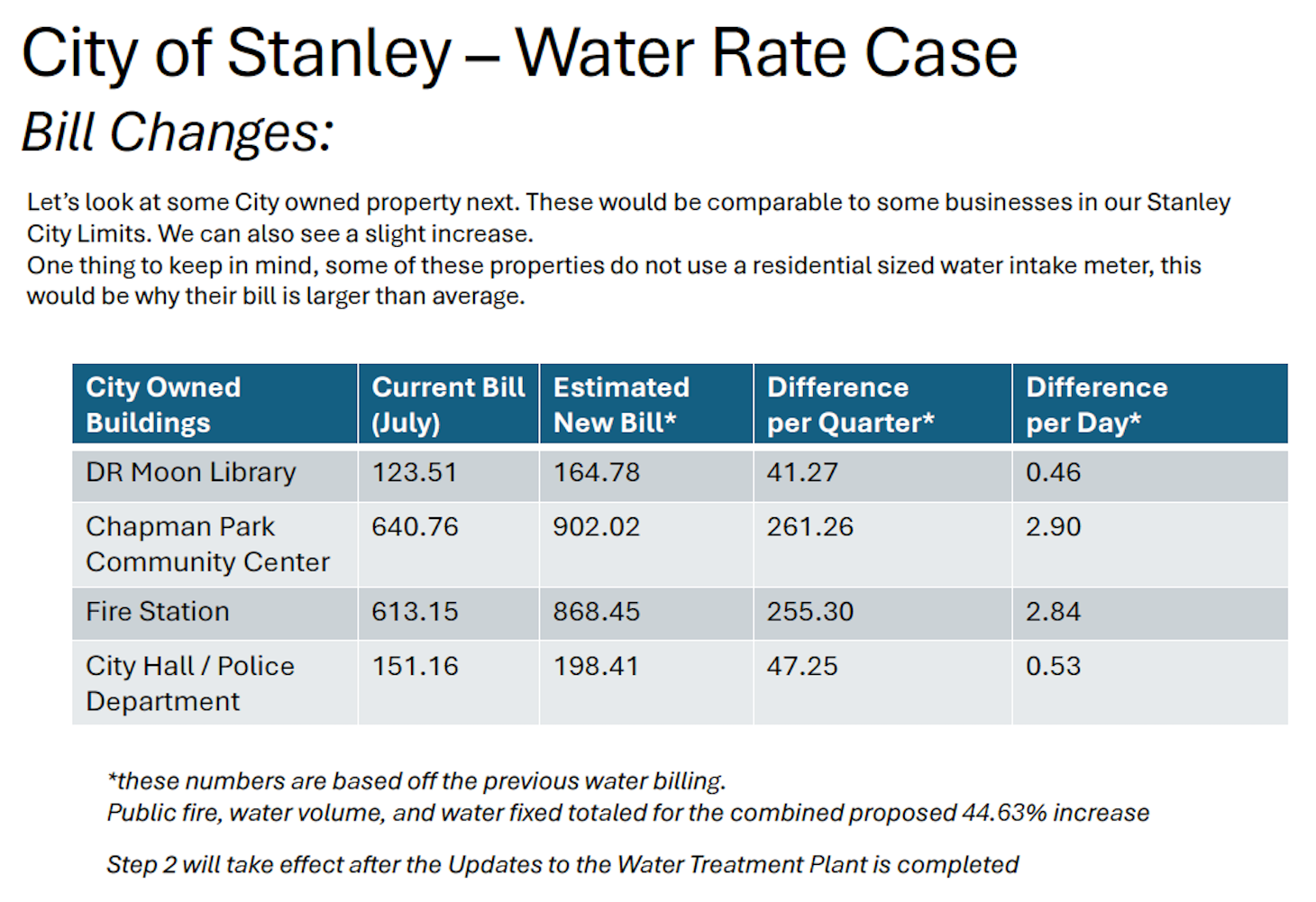
Slides released by the City of Stanley offer public building charges for a general example of Step 1 increases, meanwhile.
Starting with the D.R. Moon Library, the current July bill of $123.51 would be $164.78 under the Step 1 increase, for a difference of $41.27 or 46 cents per day. As for the Chapman Park Community Center, the current July bill of $640.76 would rise to $902.02 under the Step 1 increases, for a difference of $261.26 or $2.90 per day. For the Fire Station, meanwhile, the water bill would rise from $613.15 at present to $868.45 with the increase, for a difference per quarter of $255.30 or $2.84 per day.
For the city hall/police department, the July bill of $151.16 would rise to $198.41, for a total quarterly difference of $47.25 or 53 cents per day.
As for residents, the Step 1 increase to $9.68 per 1,000 gallons for residential customers would amount to an increase of $2.99 per 1,000 gallons to the average household water bill, alongside the meter service charge.
Divide by 1,000 and it comes out to 299 thousandths of a cent ($0.00299) more per gallon of water used.
“It’s based on usage,” Henke said during Monday’s committee of the whole meeting on the proposed Step 1 water rate increase. A subsequent Step 2 increase of approximately 59 percent will take place after upgrades to the water treatment plant.
So how do water water rates in other community’s stack up?
Starting with Thorp, volume charges go down with usage. Billed quarterly and last made effective as of January 1, 2022, volume charge rates for water use at Thorp are $7.22 per 1,000 gallons for the the first 25,000 gallons, $6.45 per 1,000 gallons for the next 75,000 gallons, $5.15 per $1,000 gallons for the subsequent 200,000 gallons above this, and $4.81 per 1,000 gallons if over 300,000 gallons are used each quarter.
Billing in rendered quarterly and becomes due and payable upon issuance following the period for which service is rendered.
As for meter service, a 5/8 inch and 3/4 inch general service charge is $44.25, with rates above this ranging from $99 (one inch) to $917 (12 inch).
Moving from Thorp to Boyd, meanwhile, volume charges are $6.67 per 1,000 gallons for the first 16,667 gallons, and $3.12 per 1,000 gallons for the second 16,667 gallons. Last effective in April of 2025 and billed monthly, the water rates at Boyd are joined by meter service charges are $10.41 per month for 5/8 inch and 3/4 inch, with additional meter charges ranging from $20.82 for a one inch connection to $239.43 for 12 inch.
As for Cadott, the monthly service charge for metered water service is $10.35 for a 5/8 inch or 3/4 inch connection, with other rates ranging from $14.00 for a one inch meter, all the way to $430 for a 12 inch meter.
Add in water volume charges and the bill increases up. Billed monthly, the first 10,000 gallons is $5.23 per 1,000 gallons, the next 60,000 gallons is $4.05 per 1,000 gallons, the next $60,000 is $3.50 per 1,000 gallons, and use of over 130,000 gallons per month is billed at $2,20 per 1,000 gallons.
Closing out the comparison with Gilman, the quarterly service charge for general water service is $60 for 5/8 inch or 3/4 inch, with connections above this ranging from one inch at $72 to 12 inch at $729.
Water volume charges at Gilman are 25,000 gallons at $10.20 per 1,000 gallons, the next 75,000 gallons at $7.20 per 1,000 gallons, the next 200,000 gallons at $6.30 per 1,000 gallons, and over 300,000 gallons each quarter at $4.70 per 1,000 gallons.
Back at the Monday meeting in Stanley, Henke shared what the proposed water rate increases ultimately mean for Stanley residents.
“What’s got to happen is the central plant has to be done, it has to be certified it’s done, and then we raise the rate at that time,” he said. “So we’re talking probably the second quarter of 2027,” he said.
Want to track your water usage in the meantime?
Try the Eye on Water app. Free and easy to use with versions for supported web browsers and smartphones alike, the water tracking app powered by Badger Meter allows users to see their daily and monthly usage, catch leaks early, and monitor conservation habits, thereby taking greater control of their city water bill.